It usually arrives at the same place. Halfway up a hill, two reps from the end, or the last few kilometres of a long run. Your legs are still working, but a voice starts making a case for stopping: this is too much, you are not ready, just walk for a bit.
Most runners try to ignore that voice or argue with it in the moment, when they have the least energy to argue. This article is about preparing what you will say to yourself before you need it.
Why does my head give up before my legs?
Because discomfort is loud and your brain is careful. When breathing gets hard and legs get heavy, it reads that as a warning and suggests the easiest fix, which is to slow down or stop. Often the warning arrives well before you actually need to stop.
That does not mean you should push through everything. Sharp pain, dizziness or feeling unwell are real signals; stop and get help. But the ordinary “this is hard and I would rather not” voice can be answered, and it gets quieter with practice.
What should I actually say?
Short and specific beats long and loud. “Come on, you can do it” fades fast. A clear instruction gives your mind a job.
Pick two or three cue words before the run and keep them ready:
- For form: “Tall and relaxed”, “Quick feet”, “Drop the shoulders”.
- For breathing: “Slow breath out”, “Steady”.
- For effort: “Smooth, not fast”, “Hold this”.
- For focus: “Just this lamp post”, “Next corner”.
Many runners find it helps to talk to themselves in the second person, like a coach would: “You have done this before. Relax your hands.” It puts a little distance between you and the discomfort, and it sounds more like advice than complaining.
How do I split a hard run into pieces?
The whole distance is too big to think about when you are tired. A piece of it is not.
- On intervals, think only about the rep you are in. The next one does not exist yet.
- On a long run, count in landmarks or minutes: to the next junction, the next water stop, the next five minutes.
- Near the end, count down instead of up. “Three kilometres left” feels shorter than “I have done eighteen”.
Each finished piece is a small win, and small wins give your head a reason to agree to the next one. If you want to see how intervals are built, read intervals explained.
What do I tell myself on Amman’s hills?
Hills are where the voice is loudest, because the effort rises fast and the top looks far away. Keep your eyes a few metres ahead, not on the summit, and run by effort rather than pace.
Useful lines here are about rhythm, not speed: “Short steps”, “Same effort”, “Arms drive”. It is fine to slow down on the climb; the hills guide explains why. Then tell yourself one more thing at the top: “Now relax and let it come back.” The recovery over the crest is part of the hill.
What about the last kilometres of a Saturday long run?
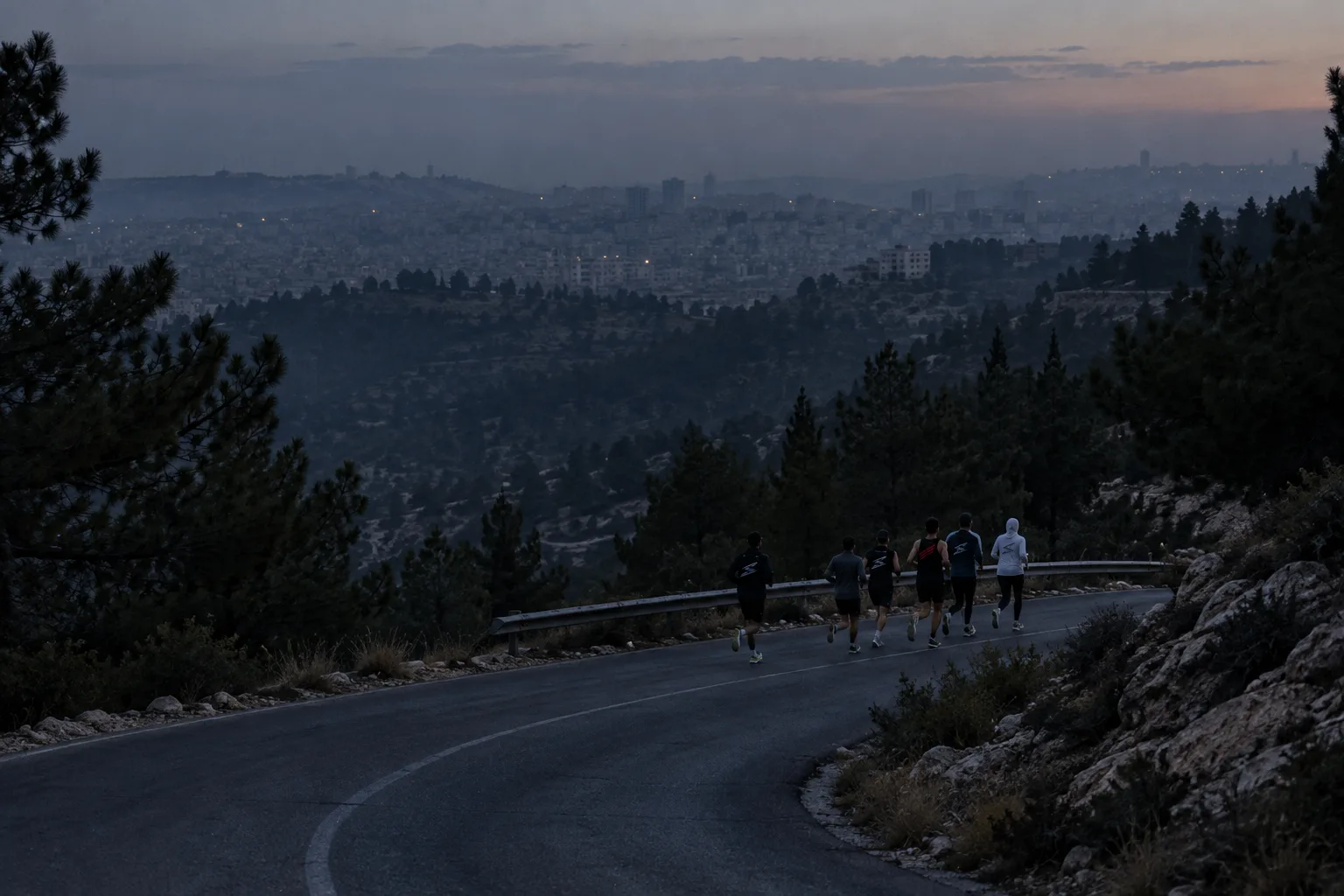
The Saturday long run at 6:30 am covers 14 to 25 km on the Dabouq hills, so the end comes when you are tired and the sun is getting stronger. This is where good preparation and good words meet.
- Before you start, decide your two cue words for the final part.
- When the voice arrives, notice it and name it: “That is just the tired voice.”
- Check the basics: have you drunk and eaten as planned? Read fuelling long runs if not.
- Switch to small pieces: one hill, one street, one minute.
- Use the group. Running next to someone and matching their steps quiets your head a lot.
If the end of long runs feels like a wall every week, the issue may be pace or fuel rather than your head. See hitting the wall.
How do I practise it?
Self-talk is a skill, so train it on ordinary days, not only on race day.
- Choose your cue words before the run, not during it.
- Use them on the hard parts of Wednesday’s session, so they already feel familiar.
- After a run, remember the moment you wanted to stop and what helped. Keep that line.
- Drop words that do not work. Not every phrase suits every runner.
How does the club help?
At the Wednesday track session at 6:30 pm, members have the coach in their ear through the app, calling reps, pace and recovery. Hearing a calm voice from outside is a good way to learn what a helpful inside voice sounds like.
New to it all? Start with the Monday Open Run at 6:30 pm at the Al Hussein Sports City track. It is open to everyone; download the app and check in. It is easy, so you can practise your cue words with no pressure.
What mistakes should I avoid?
- Long speeches in your head. Keep it to a few words.
- Only negative lines like “do not stop”. Say what to do, not what to avoid.
- Waiting until you are already struggling to think of something to say.
- Using self-talk to ignore real pain. Stop and get it checked.
- Comparing yourself with the runner ahead. Talk about your own run.
The bottom line
The hard moment in a run is predictable, so your answer to it can be too. Choose a few short cue words, speak to yourself like a coach, split the run into small pieces, and practise on ordinary days. Next time you are on a Dabouq hill or a final rep, you will already know what to say.
The easiest place to start is Monday’s Open Run: pick one cue word and try it.
General advice, not medical advice. If pain persists, see a doctor or physiotherapist.